10 December, 2025
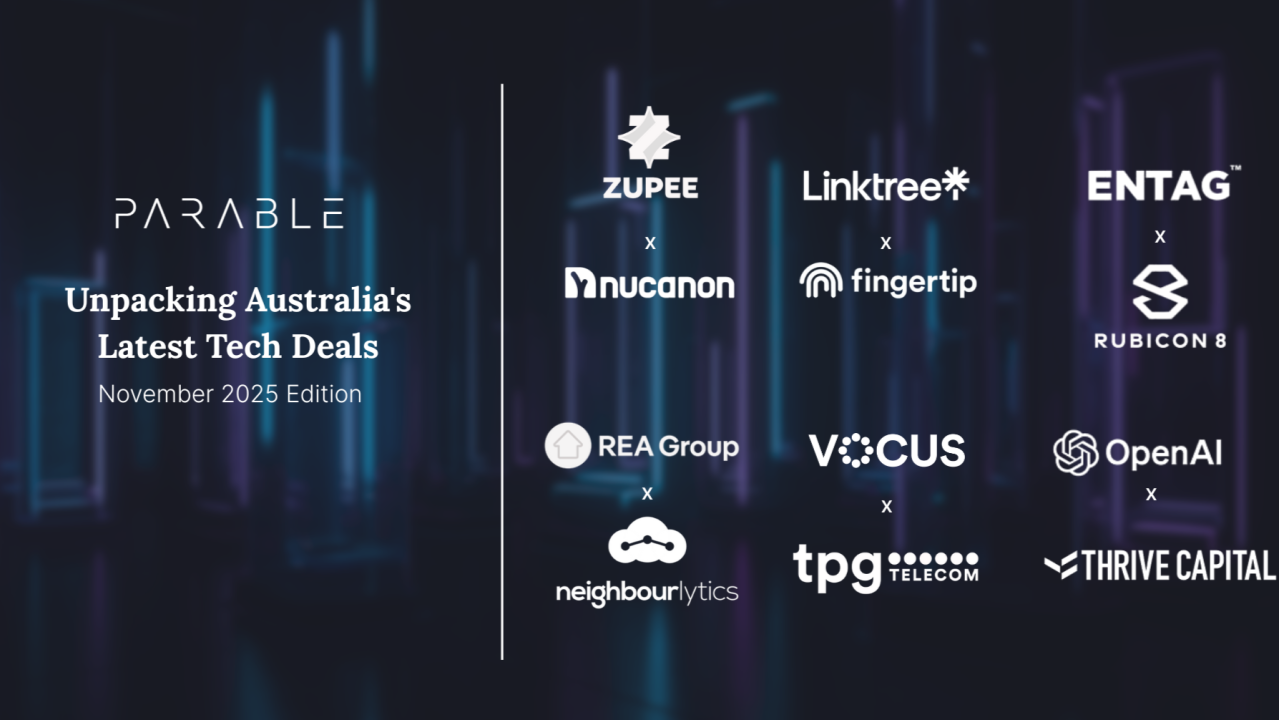
As we close out November, the deal flow in the Australian technology sector has pivoted noticeably towards ‘data depth’ and ‘strategic add ons’. While the earlier Spring window was well defined by massive infrastructure plays, this month has seen major aggregators (REA Group, Linktree) and international challengers (Zupee) acquire more niche capabilities to deepen their value proposition. The market is pushing more to buy the intelligence and engagement layers that sit on top of infrastructure. Below is a detailed analysis of the specific transactions that defined the month.
Date: 3rd November 2025; Value: ~A$5m
Indian gaming unicorn Zupee has acquired Nucanon, a Sydney-based AI startup specialising in interactive storytelling. Nucanon’s proprietary engine uses generative AI to create dynamic, branching narratives in video games where characters and plots evolve based on user choices. The acquisition sees the Sydney-based team integrating with Zupee’s product division to launch a new storytelling vertical.
This is a notable cross-border acqui-hire that signals the maturity of Australian AI talent. For Zupee, this is a strategic pivot away from pure real money gambling (which faces regulatory headwinds in India) toward social & interactive entertainment. By acquiring Nucanon, Zupee bypasses the R&D cycle required to build a generative narrative engine from scratch. It highlights a growing trend where global tech platforms act as the exit path for early-stage Australian AI startups that possess niche IP but lack the distribution scale to commercialize independently.
Date: 6th November 2025; Value: Undisclosed
Sunshine Coast-based Managed Service Provider (MSP) Entag has acquired Rubicon 8, a specialist in telecommunications advisory and network security. Entag, which is backed by Anchorage Capital Partners, has built a dominant position as a Telstra Enterprise Partner. Rubicon 8 adds depth in unified communications and managed connectivity to Entag’s mobility-first portfolio.
This deal exemplifies the thesis currently favoured by mid-market private equity. Rather than fighting for compressed margins in Sydney or Melbourne, Entag is consolidating the high-growth Queensland corridor. The strategic value lies in the expansion; as Entag can now layer Rubicon’s higher-margin managed security services onto its existing carriage contracts. It transforms Entag from a vendor-aligned reseller into a comprehensive digital transformation partner, increasing customer stickiness and valuation multiples.
Date: 13th November 2025; Value: Undisclosed
Melbourne-born unicorn Linktree has acquired Fingertip, a domestic competitor and website builder tool for creators. Fingertip offered a link-in-bio solution alongside invoicing and scheduling tools for freelancers. As part of the deal, Fingertip’s platform will be sunset in mid-2026, with the team and user base migrating to the Linktree ecosystem.
In the "Creator Economy" sector, the battle is for the "front page of the internet" where a single URL a creator uses to monetize their audience. By acquiring Fingertip, Linktree removes a competitor and absorbs its engineering talent to accelerate its own roadmap into "Commerce Features" (bookings, payments, invoicing). It reinforces the competitive dynamic in the link-in-bio category, where scale is the only defence against commoditisation.
Date: 28th November 2025; Value: Undisclosed
Digital property giant REA Group (ASX:REA) has acquired Neighbourlytics, a Melbourne-based data analytics platform. Unlike traditional property data (which measures the house), Neighbourlytics measures the neighbourhood using real-time data to track foot traffic, lifestyle trends, accessibility, and local vibrancy.
This acquisition represents a shift from "Property Data" to "Lifestyle Intelligence." As the property market tightens, REA needs to offer more than just listings to keep users engaged. Neighbourlytics allows REA to answer the subjective question with objective data. Strategically, this creates a deeper moat around REA’s listings; by embedding proprietary lifestyle scores that competitors (like Domain) don’t have, REA increases the "time on site" and provides a unique value-add to developers marketing off-the-plan projects in new/unknown suburbs.
Vocus advances TPG Telecom, Fibre Asset Acquisition
Date: 18th November 2025 (Regulatory Milestone); Value: ~A$5.2 billion
November marked a critical progression in Vocus’s acquisition of TPG Telecom’s enterprise, government, and wholesale fibre assets, with the ACCC commencing formal market inquiries. This transformational deal involves Vocus acquiring TPG’s extensive fixed infrastructure network, leaving TPG to focus on its mobile consumer business.
This is the definitive Infrastructure Consolidation play of 2025. In the age of AI, fibre is the new railroad. By consolidating these assets, Vocus creates a genuine second national backhaul network capable of challenging Telstra’s dominance. For enterprise and government clients, this matters because it creates competitive tension in the "secure transport" market essential for moving the massive datasets required for AI training. For Vocus’s owners (Macquarie and Aware Super), this locks in long-term, inflation-linked infrastructure returns protected by high barriers to entry.
Thrive Capital and OpenAI back new ‘AI - Native’ MSP Platform
Date: 28th November 2025; Value: Undisclosed
Following the official opening of OpenAI’s Australian office and its $7 billion partnership with NextDC to build a sovereign AI data centres, OpenAI’s primary backer, Thrive Capital, has made its first major move into the Australian services market. Thrive, alongside global co-investors, has backed a new managed services roll-up vehicle. This new platform is designed to acquire and consolidate mid-market Australian MSPs that specialise in data, cloud, and AI workflow integration, effectively creating a dedicated "deployment arm" for OpenAI’s enterprise stack in the region.
This is a game-changing signal for Australian MSP founders. Until now, the "buyer list" was dominated by local PE or trade buyers. Thrive Capital’s entry puts a deep-pocketed US venture firm directly onto the acquirer list. The strategy is clear: OpenAI provides the "Engine" (models), NextDC provides the "Road" (infrastructure), and this new Thrive-backed rollup will acquire the "Drivers" (MSPs) who implement the technology for clients. For the market, this creates a new premium exit category: MSPs who can demonstrate they are "AI-Native" and ready to scale OpenAI’s enterprise products will likely command significantly higher valuations from this new platform than from traditional infrastructure buyers.